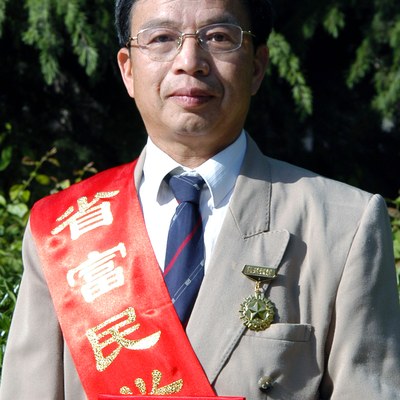
黄宝琛
Huang Baochen
人物简介
合成杜仲胶(反式异戊橡胶)产业化奠基人,发明本体沉淀聚合法。
事迹
天然杜仲胶从叶、皮提取成本高,产业化长期受限;黄宝琛另辟蹊径——以石油裂解C5馏分中的异戊二烯合成“合成杜仲胶”(高反式-1,4-聚异戊二烯,TPI)。他发明负载钛(TiCl4/MgCl2)催化异戊二烯本体沉淀聚合新工艺,催化活性较国外钒体系提高30余倍、反式-1,4结构含量≥98%、产品为粉末橡胶、无三废,成本显著低于国外溶液法。
该“高反式-1,4-聚异戊二烯的合成及应用开发”项目获2000年度国家技术发明二等奖(名列第一)。2006年建成500吨/年中试装置(产能超过当时日本唯一的400吨装置、为世界最大),随后在青岛莱西推进3万吨/年世界首套万吨级工业化装置——把“合成杜仲胶”从实验室推向规模化,为杜仲胶节油降耗的绿色轮胎应用打开产业通道。
重要活动 / 事件
- 2006年建成500t/a合成TPI中试装置,产能超日本、居世界最大
- 推动青岛莱西3万吨/年世界首套万吨级反式异戊橡胶工业化装置
- 1999年获化工部技术发明二等奖、2000年获国家技术发明二等奖
代表贡献
- 主持TPI(合成杜仲胶)合成及应用开发,获2000年度国家技术发明二等奖(第一)
- 发明负载钛本体沉淀聚合法,催化活性较国外钒体系高30余倍、反式含量≥98%
- 建成世界最大合成反式异戊橡胶装置
- 享受国务院政府特殊津贴
Profile
Pioneer of synthetic Eucommia rubber (trans-polyisoprene) industrialization.
Story
Extracting natural Eucommia gum from leaves and bark is costly, long limiting industrialization. Huang Baochen took another route — synthesizing ‘synthetic Eucommia gum’ (high-trans-1,4-polyisoprene, TPI) from petroleum-derived isoprene. His supported-titanium bulk-precipitation process raised catalytic activity about 30-fold over foreign vanadium systems, delivered ≥98% trans-1,4 content as a powder rubber with no waste streams, at far lower cost.
The project won the 2000 National Technological Invention Award (2nd Prize, first-ranked). A 500 t/yr pilot plant (2006) surpassed Japan’s sole 400 t line to become the world’s largest, followed by a 30,000 t/yr first-of-its-kind industrial plant in Laixi — bringing synthetic Eucommia gum to scale for fuel-saving green tires.
Milestones
- Built a 500 t/yr pilot plant in 2006 — the world’s largest, exceeding Japan’s
- Advanced a 30,000 t/yr first-of-its-kind industrial plant in Laixi, Qingdao
- Won ministerial (1999) and national (2000) technological invention awards
Key Contributions
- Led TPI (synthetic Eucommia gum) development — National Technological Invention Award, 2nd Prize (2000, first-ranked)
- Invented a Ti-based bulk precipitation polymerization: ~30× higher activity, ≥98% trans content
- Built the world’s largest synthetic trans-polyisoprene plant
- State Council special-allowance expert

i 杜仲 · 杜仲全产业链大数据平台i DuZhong · Eucommia Full-Chain Data Platform
iduzhong.factorydossier.com